 Women in Claude
Member story
Caroline Built an AI Patient Triage Bot in 4.5 Hours With Claude Code
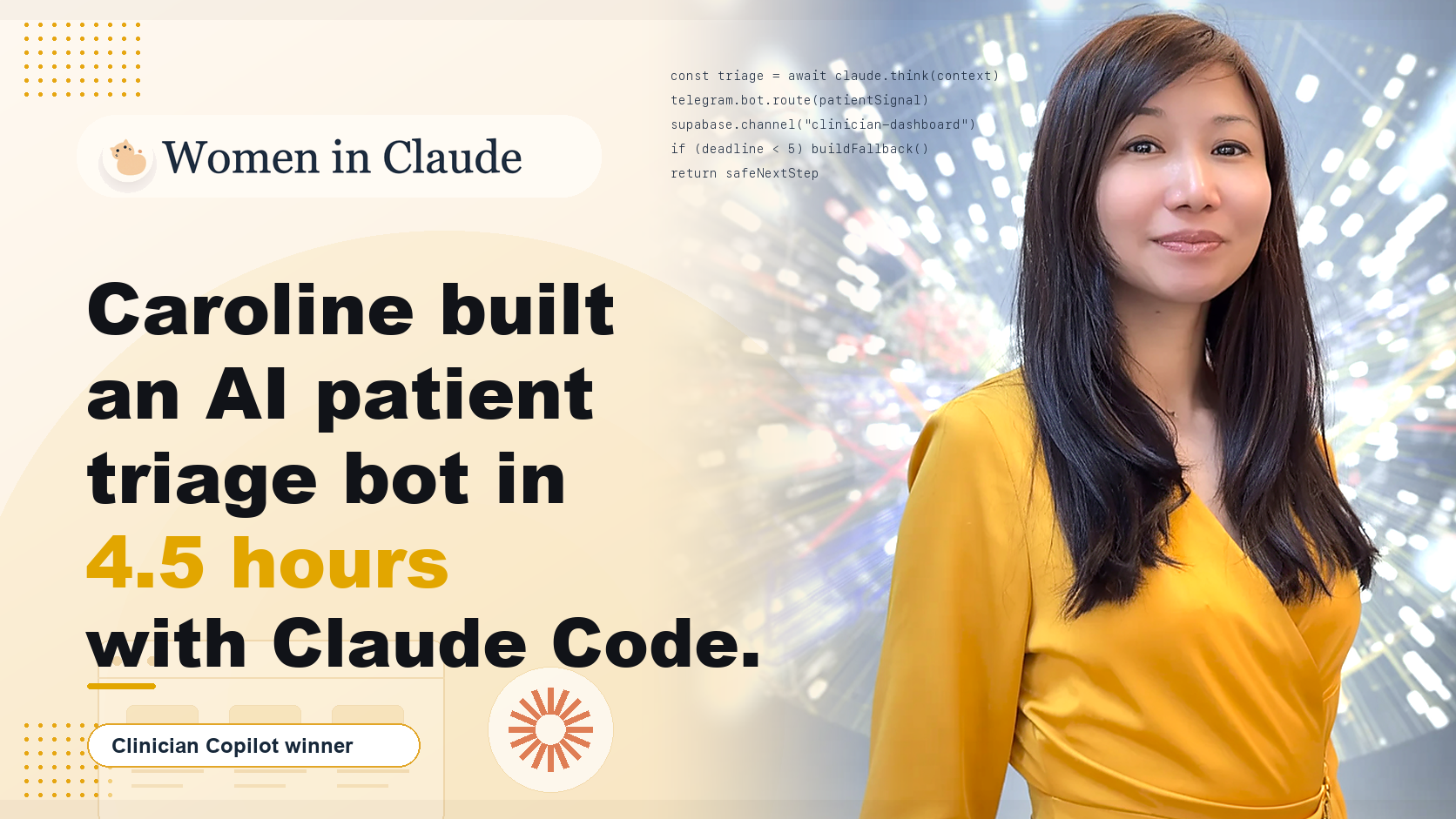
Caroline Ang used Claude Code to build an AI-powered patient triage bot in 4.5 hours at Lovable Vibeathon KL 2026.
The project had to work as a Telegram bot with clinical triage logic, OpenClaw control, Supabase Realtime integration, and a live clinician dashboard. Caroline built and submitted it largely solo, across seven AI tools, and won Track 2: Clinician Copilot.
"I'm 59. I feel like I'm just getting started."
The Problem Before Claude
Caroline had a hackathon deadline that would make even experienced developers sweat: build a working clinical triage product in 4.5 hours.
The bot needed to coordinate multiple moving parts at once. It had to run through Telegram, include clinical triage logic, satisfy the organisers' OpenClaw control requirement, connect to a friend's Supabase project in real time, and power a live dashboard for clinicians.
Traditional development would have taken days. Caroline is not a developer. She is a 59-year-old woman moving through life and growth phases, and she needed the system to become real before the deadline hit.
Claude as Pair Programmer and Orchestrator
Claude Code became Caroline's pair programmer, architect, debugger, and full-stack orchestrator for the build.
It helped configure and troubleshoot the OpenClaw gateway, diagnose schema mismatches in Supabase, enable Realtime on the right tables, verify anon key access, architect the Telegram bot, test the live workflow, and fix integration spec violations as they appeared.
When the vision API failed with 30 minutes left, Claude Code helped Caroline pivot four times before making the call to cut the feature entirely. It then built a graceful fallback in under 5 minutes.
The difference was not just speed. Claude held the full 4.5 hours of accumulated context: every architectural decision, every schema detail, every requirement, and every broken edge that needed recovery.
What Changed
Before Claude Code, Caroline thought she was using AI mostly to vibe-code on platforms: pointing at things and hoping for the best.
With Claude Code, the work felt different. She was not simply telling Claude what to do. They discussed, debugged, and made tradeoffs together. Caroline could go deeper on technical integration than she had been able to with other LLMs because Claude kept the system in view.
That changed how she saw herself. Not just as an AI educator or growth catalyst, but as a founder, builder, and entrepreneur who can make real systems.
The Measurable Shift
Caroline won Track 2: Clinician Copilot at Lovable Vibeathon KL 2026, a hackathon with 150 participants and more than 50 teams.
She built and submitted a working product in 4.5 hours across seven AI tools. The form crashed at 3:56 PM. She still submitted at 3:59 PM, on a Sunday.
The deeper result was confidence. Caroline described a different way of working with Claude Code: not just prompting, but dispatching, discussing, and building systems. As someone whose niche is systems thinking, she felt she had finally met an AI that understood what she was trying to build and could help convert it into reality.
Her Advice for Women Getting Started
Caroline tells women to start with a real problem, not a tutorial.
Give Claude context, not just questions. The deeper the context, the faster everything moves. Do not begin with your age, background, or experience as the limiting frame. The intimidation starts to disappear when you stop asking Claude to impress you and start asking it to think with you.
"It's not a shortcut. It's a thinking partner. There's a difference."
You can learn more about Caroline's work at drcarolineang.com and read her LinkedIn story.